Pray For President Trump!
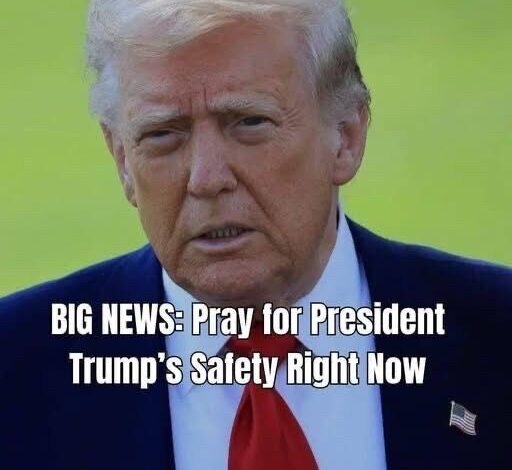
Former House Speaker Newt Gingrich is sounding the alarm about what he calls a “very dangerous” escalation in political rhetoric across the country. Speaking in a recent interview with Fox News, Gingrich warned that intensifying hostility from Democratic leaders toward President Donald Trump is deepening national polarization and threatening the stability of American democracy.
Gingrich’s remarks came after several recent statements from House Minority Leader Hakeem Jeffries and other Democrats that, in his view, crossed a line between political opposition and open provocation. “When you have national leaders encouraging contempt for law enforcement and attacking every institution that stands in their way, you’re feeding chaos,” he said. “That kind of rhetoric doesn’t just divide—it erodes trust in the very idea of government.”
He compared the current political moment to what he called a “constitutional stress test,” invoking Abraham Lincoln’s Gettysburg Address as a reminder that democracy only endures when citizens and leaders act with restraint. Gingrich emphasized that the rule of law, not emotional retribution, must remain at the core of political life. “Once people stop believing that the law applies equally,” he warned, “you stop being a republic and start being something else entirely.”
In the interview, Gingrich took aim at what he described as a pattern of disrespect among Democratic lawmakers during recent joint sessions of Congress. He accused them of showing open contempt during moments that called for unity and reflection. “They couldn’t bring themselves to applaud even the simplest, most unifying statements,” he said. “That’s not disagreement. That’s detachment. And it’s a dangerous sign of a party that’s lost interest in governing.”
According to Gingrich, the issue isn’t just tone—it’s direction. He argued that the Democratic Party has become more focused on obstruction and symbolism than on practical solutions. “You can’t lead a country when your main strategy is to say ‘no’ to everything,” he said. “Leadership means offering an alternative vision, not just tearing down your opponents.”
Gingrich’s concerns go beyond partisan friction. He cited internal polling conducted by his conservative research group showing that 82 percent of Americans now believe the political system is corrupt. He called that statistic “terrifying,” saying it reflects a deep erosion of confidence that could, if left unchecked, destabilize democratic institutions. “When four out of five people think the system is rigged,” he said, “you’re not far from a crisis. That’s the moment where people stop believing in ballots and start looking for other solutions.”
He argued that both major parties bear responsibility for the rising anger, but he placed more blame on Democratic leaders for what he described as deliberate escalation. Gingrich accused them of using inflammatory language to energize their base while ignoring the long-term damage such tactics cause. “They think short-term outrage wins elections,” he said. “But what it really does is burn down the bridges you need to govern after you win.”
Still, he acknowledged that Republicans are not immune to the same temptations. “We’ve got people on our side who also go too far,” Gingrich admitted. “When you start calling fellow Americans your enemies, you’ve already lost something essential. You’re no longer debating ideas—you’re fighting a civil war in words.” He warned that protests targeting politicians’ homes or families have crossed into unacceptable territory. “That’s not free speech—that’s intimidation. We’re at a point where the rule of law has to mean something again.”
Gingrich’s broader message was that America’s institutions are being tested in ways not seen in decades. He said that the “political oxygen” is being consumed by anger rather than problem-solving. The result, in his view, is a government too busy fighting itself to govern effectively. “We have crises at the border, inflation that’s squeezing working families, and international instability that requires clear-headed leadership,” he said. “Instead, we have politicians who seem more focused on scoring viral clips than delivering results.”
He also defended high-profile business figures like Elon Musk, arguing that public attacks on those who cooperate with the Trump administration or challenge progressive orthodoxy reflect a larger cultural problem. “You can disagree with Musk or anyone else,” Gingrich said, “but when disagreement turns into coordinated smear campaigns, you’re telling innovators and entrepreneurs that dissent isn’t allowed. That’s poison for a free society.”
In his view, the media has played a major role in fueling division. Gingrich accused mainstream outlets of amplifying outrage and suppressing nuance, creating echo chambers that feed both sides’ worst instincts. “The media has become a conflict industry,” he said. “The louder the fight, the higher the ratings. But the casualty is truth—and the country.”
Gingrich urged both parties to take a step back before the situation spirals beyond repair. He said that political leaders must set an example by prioritizing policy results and civility over performance politics. “It’s not about liking each other,” he said. “It’s about understanding that our system only works if both sides respect the process. If we lose that, everything else goes with it.”
Looking ahead to the 2026 midterm elections, Gingrich predicted that the public’s growing frustration with dysfunction will be the defining force. He expects voters to punish whichever party they see as more responsible for gridlock. “People are tired of theater,” he said. “They want to see bills passed, problems solved, and leaders who act like adults. If either party can deliver that, they’ll own the future.”
Gingrich described the current era as a crossroads for American democracy—one where the habits of anger, cynicism, and tribalism could become permanent unless reversed. “We’re seeing the breakdown of shared facts, shared values, and even shared language,” he said. “If we can’t agree on what’s real, we can’t govern. And if we can’t govern, the country starts to unravel.”
He ended with a note of guarded optimism, saying that the same public disillusionment driving polarization could also spark renewal if leaders respond responsibly. “When people lose faith in the system, it’s a warning—but it’s also an opportunity,” Gingrich said. “If we can channel that anger into reform, transparency, and accountability, then maybe this crisis becomes a turning point instead of a collapse.”
For now, however, Gingrich’s message is clear: the nation’s political temperature is reaching dangerous levels, and both parties are responsible for turning down the heat. “Democracy depends on rules, respect, and restraint,” he said. “Right now, we’re running low on all three. It’s time for adults to take charge again.”
As 2026 approaches, his warning resonates far beyond partisan lines. The country faces a stark choice between escalation and restoration—between letting the politics of resentment dictate the future or rediscovering the discipline that once held the system together. Gingrich’s appeal, stripped of spin, is simple: if America wants to preserve its democracy, it has to start acting like one.