How Many Brothers Are There?

Riddles have a unique way of making our brains work harder than expected, and today’s puzzle is no different. It combines a simple mathematical concept with a clever twist in language, making it a classic example of how riddles often trick us with their wording.
The riddle goes like this:
“I have 4 brothers, and each brother has 4 brothers. How many of us are there?”
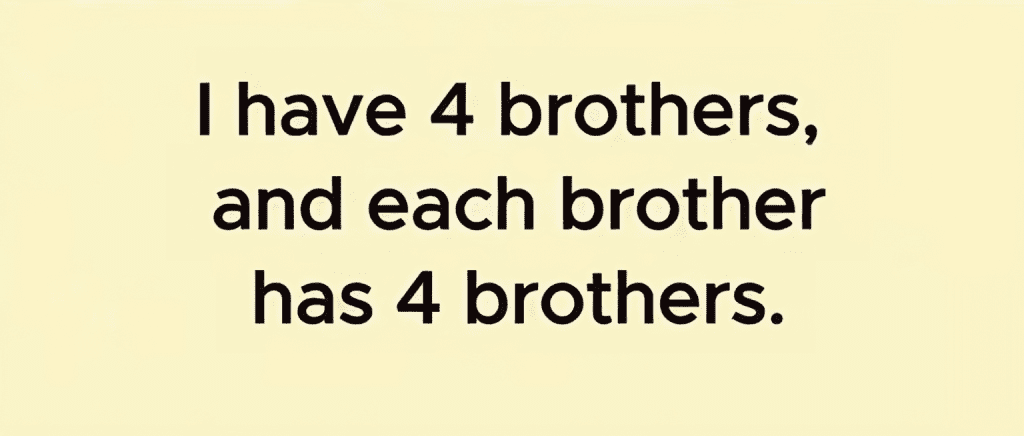
At first glance, it seems confusing, but once we break it down logically, the solution is much clearer than it first appears. Let’s dive into the step-by-step process of solving this riddle!
Step 1: Identifying the Speaker
The first thing we need to do is figure out who’s talking. The person speaking says, “I have 4 brothers.”This means the speaker is part of a group of brothers, so we should include him in the total count. Remember, the speaker is also a brother!
So, right away, we know that there are at least 5 brothers: the speaker and the 4 brothers he mentions.
Step 2: Interpreting “Each Brother Has 4 Brothers”
The next part of the riddle says, “Each brother has 4 brothers.” Now, this is where the riddle might trip some people up, because it seems like we should keep adding more brothers. But here’s the important part:
The 4 brothers that each brother has includes the speaker! In other words, each of the speaker’s brothers considers the original speaker as one of their 4 brothers. So, no new brothers are being introduced. We are still dealing with the same 5 brothers—nothing more, nothing less.
Step 3: Putting It All Together
At this point, we know that:
- The speaker is part of a family of brothers.
- He has 4 brothers.
- Each of these brothers also has 4 brothers, which includes the speaker.
Since no extra brothers are added through this statement, the total number of brothers remains constant. Therefore, the total number of brothers is 5.
The Final Answer: 5 Brothers
The answer to the riddle is simple: There are 5 brothers in total. The original speaker is one of them, and he has 4 brothers, making the total number 5.
Why This Riddle Can Be Confusing
The confusion in this riddle comes from how it’s worded. When the riddle says “each brother has 4 brothers,” many people instinctively think they need to add more brothers for each individual, which leads to a higher and incorrect count. However, the key to solving the riddle is realizing that the brothers being mentioned are all part of the same group of 5 siblings. No new brothers are being introduced; it’s just the same 5 being referred to multiple times from different perspectives.
Common Misinterpretations
- Adding More Brothers Than Necessary: People often think that each brother having “4 brothers” means more people need to be added to the group. But in reality, it’s just restating the relationship between the same set of 5 brothers.
- Overthinking the Math: This riddle doesn’t require complicated math, but the tricky wording makes it seem like you should do more calculations than needed. Once you understand that each brother already counts the speaker as one of their 4 brothers, the solution becomes obvious.
Understanding the Power of Language in Riddles
This riddle teaches us an important lesson about how language can shape our thinking. In riddles, sometimes what appears to be a complex situation is simply a clever use of words meant to mislead. The phrase “each brother has 4 brothers” is true, but it doesn’t mean we need to add new people—it’s just a way of restating the fact that the speaker and his 4 brothers are all part of the same family.
Conclusion: The Simplicity of Riddles
Riddles like this are designed to make us think outside the box and reconsider how we approach simple statements. By breaking the problem down logically and not overcomplicating things, we can easily arrive at the correct solution.