Cashier Laughed At Old Woman Counting Pennies So I Did Something That Got Me Arrested
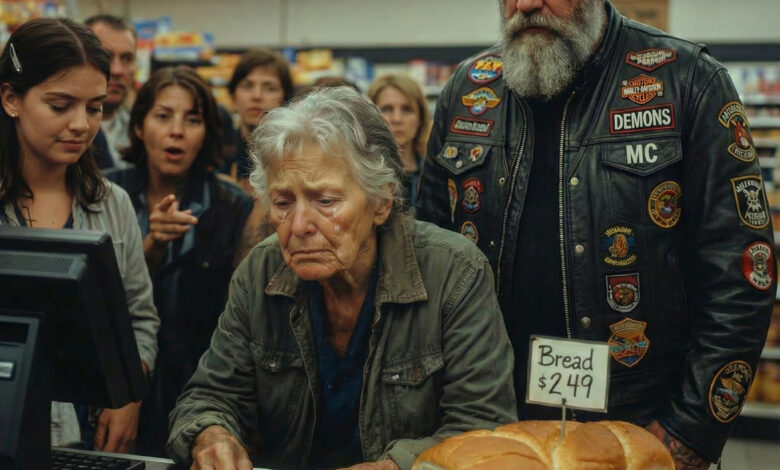
The cashier started laughing at an old woman who was counting out pennies for a loaf of bread, and something in me snapped right there in the checkout line. I’ve lived sixty-seven years, ridden forty-three of those on two wheels, and I’ve seen my fair share of ugly behavior—but nothing hit me like that moment did.
She couldn’t have weighed more than a hundred pounds. Eighty, maybe eighty-three years old. Shoulders curled in, hands trembling with arthritis as she pushed coins across the counter—pennies, nickels, a few dimes she must’ve dug out of a jar at home. She counted slowly, whispering numbers under her breath, losing her place, starting over. Just trying to buy a $2.49 loaf of bread.
“Ma’am, you’re twenty-three cents short,” the cashier told her, rolling her eyes so hard I swear I heard it. “And there’s a line.”
The old woman apologized like she’d committed a crime. “I thought I had enough,” she whispered. “Let me… let me count again.”
Someone behind me groaned, loud and impatient. “Come on, lady. Some of us have places to be.”
Her chin wobbled. Tears welled up. Tears—over a loaf of bread she couldn’t afford while a store full of people just watched.
That’s when the cashier laughed. Not a nervous laugh. Not a slip. A real, dismissive giggle. “Maybe try the food bank next time, hon.”
I stepped forward before I even knew I was moving. Slapped a twenty on the counter hard enough that the pennies jumped. “Her groceries are on me,” I said. “And you’re going to apologize to her. Right. Now.”
The cashier blinked. “Excuse me?”
“You heard me.”
“I don’t have to—”
“You laughed at her,” I growled. “You humiliated an elderly woman over pocket change. Own it.”
People in line suddenly went quiet. The kind of quiet where you realize you should’ve spoken up but didn’t.
A manager rushed over, straightening his tie like that made him more authoritative. “Sir, what seems to be the problem?”
“The problem,” I said, “is your employee mocking a senior citizen for being poor.”
The old woman tugged my sleeve gently. “Please,” she whispered. “I don’t want trouble. I’ll just go.”
“No ma’am,” I told her. “You’re not going anywhere without that bread. You did nothing wrong.”
The manager sighed, clearly annoyed at the ‘scene.’ “Sir, if you can’t calm down, I’ll have to call the police.”
And that’s when her sleeve slipped.
The faded numbers inked into her forearm stopped the world cold.
I’ve seen those numbers before—in documentaries, in museums. Not in real life. Not tattooed on the skin of a trembling woman standing in a grocery store crying over two dollars and some change.
“Ma’am,” I asked quietly, “were you in the camps?”
She looked up with eyes too tired for someone who had survived so much. “Auschwitz,” she said softly. “I was fourteen.”
The entire checkout line went silent.
I turned to the manager. “She survived Nazis, starvation, losing her entire family. And you’re letting your cashier laugh at her because she’s twenty-three cents short for bread?”
The manager paled. The cashier stared at the floor, shaking.
I didn’t wait for a response. “I’m paying for her groceries. All of them. And if you want to call the police, go ahead—because when they arrive, I’ll tell them exactly what happened.”
Suddenly, no one wanted the police involved.
The manager stammered out an apology. The cashier whispered one, too late and too small. The woman only nodded—she wasn’t interested in apologies. She just wanted dignity.
I carried her bread to her cart. “Do you need anything else?” I asked.
She looked at me like she couldn’t understand why someone would help her. “Why are you being so kind?”
“Because it’s the right thing to do,” I told her. “And because my mother would rise from the grave and strangle me if I walked away from this.”
She almost smiled. “Your mother raised you well.”
“She tried,” I said.
We walked the aisles together. Her name was Eva. Eighty-three years old. Lived alone. Husband gone six months. Only son passed years earlier. She was living on $1,247 a month in Social Security. Rent was $950. That left her with about $300 to survive on. She was choosing between food and heat. Between medicine and electricity.
Between feeding herself… and feeding her cat.
“I give my food to Misha,” she told me. “She is all I have left.”
That sentence made my chest hurt.
I didn’t let her argue. I filled three carts with groceries—real food, not the cheapest cans. Food for her. Food for Misha. Basic household items she’d stopped buying because they were “too expensive now.” The total was nearly five hundred dollars. I didn’t hesitate.
People stared. Good. They needed to.
I loaded everything into my bike trailer, and she laughed softly. “A biker,” she said. “I should have known.”
“Does that bother you?” I asked.
She shook her head. “I survived Mengele. A man on a motorcycle does not frighten me.”
At her apartment, I unloaded the groceries and met Misha, a skinny old cat who immediately climbed onto my lap like she’d been waiting years for someone to show up.
I made Eva a sandwich because I realized she hadn’t eaten.
Then she showed me photos—her family before the war. Thirty-seven people. She was the only one who survived.
We sat quietly for a long time before she said, “Why did you really help me? Tell me.”
I thought about the years I’d wasted, the people I’d failed, the daughter I hadn’t spoken to in four years. And I told her the truth.
“Because I want to be a man my mother would be proud of,” I said. “Because I’m tired of walking past people who need help.”
Eva squeezed my hand with her frail fingers. “Then keep going,” she said. “Do not let the world turn you hard.”
I visited her again the next Sunday. And the one after that. She told me stories that should’ve broken anyone, yet she was still gentle. Still kind.
At her urging, I called my daughter. We’re talking again. Trying again.
My biker brothers found out about Eva. Now they visit too. She calls us her “scary grandsons.” She makes tea and tells us about liberation day—the American soldier who carried her to the medical tent, crying the entire time.
When she got pneumonia, twenty-three bikers filled the hospital hallway, refusing to leave. Nurses were terrified until Eva woke up, saw us, and said, “My boys.”
She’s home now. Still fragile, still fighting.
And every Sunday, she waits for us.
I thought I saved her that day. But she saved me. She reminded me what compassion looks like. What loyalty feels like. What humanity should be.
The world laughed at an old woman counting pennies.
But that old woman is the strongest person I’ve ever met.
And she’s family now.
Because real family isn’t blood.
It’s the people who show up—especially when nobody else will.