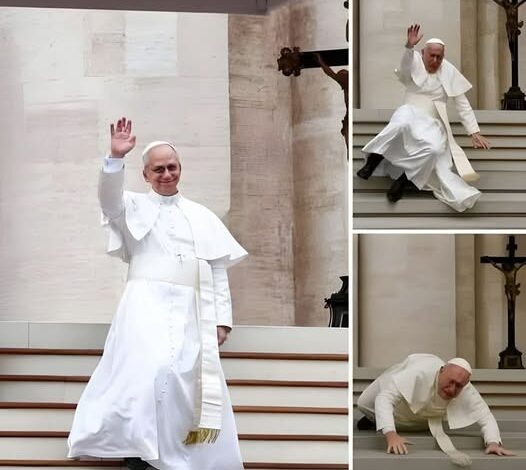
BREAKING – Lion XIV Injured After Equipment Malfunction!
The inauguration of Pope Leo XIV unfolded at dawn in St. Peter’s Square, a moment layered with tradition, symbolism, and the weight of a Church stepping into a new era. As the first rays of sunlight spilled over the ancient stones, tens of thousands of faithful gathered shoulder to shoulder, waiting to witness the beginning of a papacy many already believed would be historic. The air carried a reverent hush, broken only by murmured prayers and the low hum of anticipation that came every time the massive screens flickered or the choir shifted into another hymn.
Dressed in traditional vestments, Pope Leo XIV walked slowly toward the altar, each step deliberate, grounded, and almost contemplative. He looked less like a man performing a ceremony and more like someone embracing a destiny he’d spent his life preparing for. When he received the Palio—a simple woolen band that rested softly on his shoulders—the crowd fell silent. The gesture was ancient, but with Leo XIV it carried fresh meaning. The Palio represented pastoral responsibility, the humility of service, and the burden of guiding millions of souls. Watching him bow his head, it was impossible not to sense how deeply he felt that responsibility.
Moments later, the Fisherman’s Ring was placed on his finger, gleaming in the morning light. The ring linked him directly to Saint Peter, the first shepherd of the Church, and symbolized his duty to lead with courage even when the seas grew rough. When he lifted his hand to acknowledge the crowd, applause rippled outward like a wave.
For many, Leo XIV represented both continuity and renewal. Only the second pope from the Americas, he embodied the increasingly global identity of modern Catholicism. Though born in Chicago, his heart was unmistakably tied to Latin America. And when he opened his first address speaking in warm, fluent Spanish, the crowd erupted in cheers that echoed across the square. He thanked the people of Chiclayo, Peru, with obvious affection, crediting them for shaping his early understanding of community, faith, and service. His time there had been transformative, and he spoke about those years with the kind of clarity that only comes from a place seared into a person’s spiritual DNA.
He first traveled to Peru in 1985, a young seminarian filled with questions and idealism. He found his calling not in classrooms or formal rituals, but in dusty roadside chapels, crowded markets, and long conversations with families who lived with hardship yet carried joy like a fire that never dimmed. He worked in parishes where the doors were never locked, where the lines between giving and receiving were blurred, and where humility was not a virtue but a survival skill. It was there he met a small circle of elders who, in their quiet way, told him something he never forgot: that one day, he would be called to lead far beyond anything he imagined. Standing at the inauguration decades later, he hinted at that prophecy, describing it only as “a truth spoken before its time.” The mystery of that moment hung in the air, inviting reflection and curiosity.
What struck people most during the ceremony wasn’t grandeur—it was sincerity. He didn’t rush. He didn’t speak as if delivering a performance. He spoke as someone who had listened to the stories of fishermen, teachers, farmers, widows, and children, and who believed leadership meant carrying those stories with him. He spoke about tradition not as something to be preserved behind glass, but as a living inheritance meant to guide action. His gestures toward inclusivity felt natural, not strategic. He embodied compassion without showmanship, and the world recognized it instantly.
Observers noted how seamlessly he bridged two worlds. He honored ancient rites with the reverence they deserved, yet he carried himself with the approachability that defined Pope Francis’s tenure. The youth-focused energy of his predecessor pulsed beneath the surface of his words. He didn’t promise dramatic change, but he signaled openness—listening before acting, understanding before judging, welcoming before dividing. In a moment when the Church faced enormous internal and external pressures, his presence alone suggested steadiness.
People who had watched him rise through Church ranks described him as someone who never forgot a face or a name. He remembered stories, asked about people’s families, and often arrived unannounced at parishes to sit quietly among the congregation before Mass. His leadership style wasn’t forged in power, but in fieldwork—visiting villages, comforting the sick, organizing youth groups, repairing storm-damaged chapels with his own hands. His papacy already felt grounded in those lived experiences.
As he continued his first address, he spoke about his hopes for a Church that could be both steadfast and compassionate, rooted and evolving. He didn’t frame faith as an institution, but as a relationship—between people, between cultures, between generations. He said the Church must be large enough to hold both conviction and mercy, both tradition and imagination. His words struck a chord with those who had long waited for a leader who could balance reverence with relevance.
The ceremony ended with the choir swelling into a final hymn, and Pope Leo XIV walking among the crowd instead of retreating immediately to the Vatican. People reached for his hands, and he stopped often, bending down to greet children or bless elders leaning on canes. Cameras struggled to follow him because he refused to move through the square like a distant figure. He moved like a man connected—to his people, to his past, to the enormous task ahead.
As evening fell, conversations around the world echoed with the same sentiment: this inauguration marked more than the start of a new papacy. It marked the beginning of a new chapter where ancient tradition met the pulse of modern faith. Leo XIV entered the role with the calm of someone who understood the weight and the wonder of it, and with the humility of someone who never expected to stand on such a stage but always prepared his soul just in case.
His leadership, born from decades of service and shaped by diverse communities across the Americas, promised to be a journey not just for him, but for the millions who would walk beside him. A papacy rooted in reverence and lifted by hope. A beginning filled with optimism, shaped by memory, and ignited by purpose.
And as the world watched those first moments of his stewardship, one truth settled across St. Peter’s Square like a blessing: the Church had entered a new dawn—quiet, steady, and full of possibility.