My Stepmom Destroyed the Skirt I Made from My Late Dads Ties, Karma Knocked on Our Door That Same Night
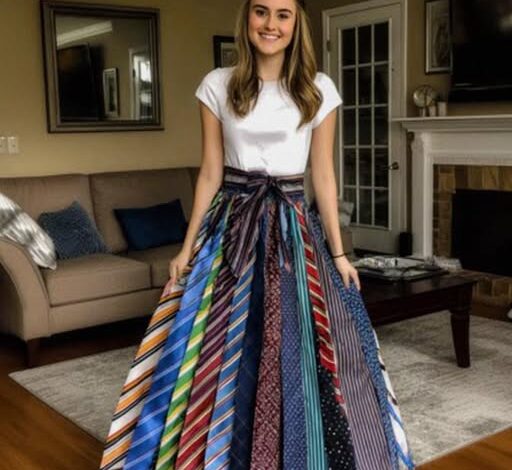
When my father died last spring, the world went still. It wasn’t just grief—it was silence, the kind that hums in your bones. He’d been my anchor, my cheerleader, my constant. Pancake breakfasts too sweet to finish, bad jokes he thought were gold, and pep talks that always ended with, “You can do anything, sweetheart.” After losing Mom when I was eight, it had been just the two of us—until he remarried.
Carla came into our lives like a cold draft. Her perfume smelled like frozen flowers, her smiles never met her eyes, and every word from her mouth seemed polished to hide a blade. When Dad’s heart gave out, she stood at the hospital dry-eyed, composed. At the funeral, when I nearly collapsed beside his grave, she leaned close and whispered, “You’re embarrassing yourself. He’s gone. It happens to everyone.” I couldn’t even respond. My voice was gone—swallowed by grief.
Two weeks later, she started “decluttering.” Suits, shoes, cufflinks—all gone. Then came the ties. Dad’s ridiculous, wonderful ties: paisleys, bold stripes, even one printed with tiny guitars. “He’s not coming back for them,” she said, tossing them into a garbage bag. The minute her back was turned, I pulled that bag out of the trash and dragged it to my room. Every tie smelled faintly of cedar and his cheap cologne. I pressed one to my face and swore I’d never let them go.
Prom was creeping up, though it felt like a cruel joke. What was there to celebrate? One night, sitting cross-legged on the floor with that bag of ties, a thought caught in my chest: If he can’t be there with me, maybe I can take him along. I didn’t know how to sew, but YouTube did. I learned by stabbing my fingers more than once and unpicking a thousand crooked seams. Slowly, those ties became something new—a skirt. Each one a piece of him: the paisley from his big interview, the navy one from my middle school recital, the silly guitars from every disastrous Christmas breakfast. When I finally zipped it up, the silk shimmered, and for the first time in months, I felt warmth instead of loss.
Carla saw it before I left for school. She leaned against my doorframe, gave a short laugh, and said, “You’re wearing that? It looks like a craft project gone wrong.” Then, just as she turned away, she added, “Still milking the orphan act, aren’t we?”
I hung the skirt back up, trembling. Her words hurt, but I refused to let her be right. That skirt wasn’t pity. It was love.
The next morning, I woke to the scent of her perfume—sharp, invasive. My closet door was open. The skirt lay on the floor in tatters. Seams ripped apart, threads dangling, some ties shredded beyond repair. “Carla!” I shouted. She appeared in the doorway, holding a cup of coffee, her expression lazy. “Hideous,” she said simply. “I did you a favor.”
I dropped to my knees, gathering the pieces in my arms. “You destroyed the last thing I had of him.”
She sipped her coffee. “He’s dead. Ties won’t resurrect him.” Then she walked out and slammed the door.
I texted my best friend, Mallory, barely able to type through the shaking. Twenty minutes later, she showed up with her mom, Ruth—a retired seamstress with hands that looked like they’d mended a thousand heartbreaks. They didn’t ask questions. Ruth took one look at the wreckage and said, “We’ll fix it, sweetheart. Your dad will still walk you into that room tonight.”
We spread the pieces across my bedroom floor. For hours, Ruth stitched, patched, and reinforced every tear. Some ties were too far gone, so she layered and shortened the skirt to save it. When I tried it on again, it wasn’t the same—but it was stronger. The visible seams looked like scars, proof of survival.
By six o’clock, I pinned one of Dad’s cufflinks to the waistband and walked downstairs. Carla glanced up from her phone and made a face like she’d bitten into a lemon. “Still wearing that mess? Don’t expect me to take pictures.” I didn’t answer. Mallory’s car honked outside, and I left without looking back.
Prom was magic. The gym lights caught the silk and scattered color across the floor like stained glass. People stopped me, touched the fabric, asked questions. “My dad’s ties,” I told them. “He passed away this spring.” Every time I said it, the words hurt a little less. My teachers blinked fast, trying not to cry. Friends squeezed my hands. One whispered, “That’s beautiful.” For the first time since Dad died, I didn’t feel broken. I felt carried.
Near the end of the night, Mrs. Henderson—the art teacher who’d always encouraged me—walked over and handed me a small ribbon labeled Most Unique Attire. She pinned it beside the cufflink and said softly, “He’d be proud of you.” I believed her.
But the night wasn’t done writing its story. When Mallory’s parents dropped me off, flashing lights painted our driveway red and blue. Two police cars, an officer at the door. Carla stood inside, pale for the first time in her life.
“Do you live here, miss?” one officer asked. I nodded, confused.
“We have a warrant for Carla,” he said. “Insurance fraud and identity theft.”
Carla spun around, pointing at me. “She set this up! She’s lying!”
“I didn’t even know,” I stammered.
The officer’s voice stayed calm. “Your employer reported it this morning. False medical claims under your late husband’s name and Social Security number.” Another officer came out holding her purse and phone. They cuffed her as she shouted. “You’ll regret this!”
The first officer looked at her, then at me. “Ma’am, you’ve got enough regrets for tonight.”
The door closed with a heavy finality. Sirens faded into the distance, leaving the house eerily quiet.
Three months later, the case is crawling through court. Over $40,000 in fraudulent claims. Delays, hearings, lawyers. But the house feels lighter now. My grandmother moved in—Dad’s mom—with three suitcases and a cranky cat named Buttons. “I should’ve come sooner,” she said, hugging me so tightly I could barely breathe.
She makes Dad’s eggs too runny every Sunday, tells stories about how he used to tape his glasses together with duct tape, and keeps his photo on the mantel where the afternoon sun always finds it. The house smells like lavender and coffee again, and sometimes, laughter.
The skirt hangs on my closet door. The scars from that night are still visible—some seams puckered, a few frayed edges—but I wouldn’t change a thing. When I touch the silk, I don’t think about what Carla destroyed. I think about what we saved. I think about Ruth’s steady hands, Mallory’s quiet loyalty, and my father’s love stitched into every inch of fabric.
It’s no longer a memorial—it’s a reminder. Love doesn’t vanish when life rips at the seams. It endures, stronger in the places it’s been mended.
When I wear that skirt now, I don’t feel like I’m holding on to the past.
I feel like I’m walking with it—alive, stitched, and standing beside me still.