She Unlocked Her Diner for 12 Stranded Truckers in a Blizzard! But What Unfolded 48 Hours Later Left the Whole Town Buzzing With Envy
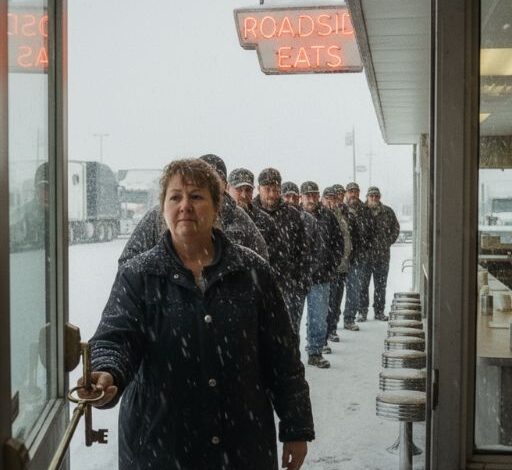
The storm came faster than any forecast had warned. By the time I turned my old sedan into the diner’s lot, the world was nothing but swirling white. I hadn’t planned to open—who’d be driving through this mess?—but then I saw the trucks. A dozen eighteen-wheelers lined up along the shoulder, headlights glowing like dying embers, their drivers huddled against the wind.
One man knocked on the door, face raw from cold, beard crusted with frost. “Ma’am,” he said, breath clouding in the air, “any chance we could get some coffee? Roads are closed. We can’t make it to the next stop.”
I hesitated. Running the diner alone was hard enough on a slow day, let alone during a blizzard with a dozen hungry men. But then I heard my grandmother’s voice in my head: When in doubt, feed people.
So, I flipped the deadbolt, switched on the lights, and waved them in.
They filed inside—boots heavy with snow, faces tired but grateful. I brewed coffee by the gallon and fired up the griddle. Before long, the place smelled like bacon and pancakes. The silence thawed as laughter took over. “Angel in an apron,” one of them said, and I pretended my cheeks weren’t red.
We were strangers, but the storm made that feel irrelevant. As the night wore on, they helped themselves to chores without being asked. Roy, a broad-shouldered man with a Tennessee drawl, washed dishes. Vince pulled a dented guitar from his rig and filled the room with old country songs. A few of them napped in booths, boots kicked off, caps over their eyes. Outside, the wind screamed against the windows, but inside it felt like family.
By morning, the radio confirmed what we already knew: no plows were coming. The highway was buried under drifts. I did a quick inventory and realized I had maybe ten pounds of flour, a handful of canned goods, and the last of last week’s brisket. Roy caught the look on my face.
“You okay, Miss?” he asked.
“Just trying to figure out how to stretch biscuits into three days.”
He nodded, then turned to the others. “Boys, time to earn our keep.”
In an hour, my little diner turned into an outpost of teamwork. Vince shoveled a path from the rigs to the door. Dennis patched a leaking pipe under the sink using parts scavenged from his truck. Another driver repaired a ripped vinyl booth with duct tape and surgeon-level focus. We made stew out of brisket scraps and canned vegetables, passing bowls around like it was Thanksgiving.
When I finally sat down, Roy slid me a steaming bowl. “This place feels like home,” he said softly.
The words hit me in the chest. Since my husband died, I’d kept the diner running because I didn’t know what else to do. I fed people but never stayed still long enough to feel anything myself. That night, though, the warmth and noise soaked through me like the first cup of coffee after a long winter walk.
On the third morning, the wind slowed and sunlight finally broke through. A local farmer pulled up on his tractor to say the main road would reopen by sundown. Relief came with an ache I didn’t expect. The men cleaned the diner before they left—stacking chairs, wiping counters, scrubbing the grill until it gleamed. When they were ready to go, Roy handed me a folded piece of paper.
“We got to talking,” he said, a little sheepish. “One of the boys used to haul gear for a TV production crew. Still knows people. You’ve got a story worth telling.”
The note had a name, a number, and three words scrawled at the bottom: Food Network—regional producer.
I laughed, assuming it was a kind gesture, nothing more. But a week later, my phone rang. Melissa from the Food Network wanted to hear about “the blizzard diner.” One call became three. Then a small crew showed up to film. I cooked biscuits and gravy with shaking hands while they captured not just the food but the laughter, the music, the makeshift family that storm had created.
When the episode aired, everything changed. People drove from towns I’d never heard of just to eat breakfast at Millstone Diner. A woman cried into her oatmeal and told me I reminded her of her late mother. Someone started a GoFundMe “to keep Millstone Diner running forever.” Within weeks, donations hit $25,000—enough to buy a new fryer, fix the roof, and finally seal the drafty windows that had whistled through every winter.
The attention did more than save my business—it revived the whole town. Millstone had been fading for years: empty storefronts, quiet streets, good people barely hanging on. Suddenly, day-trippers filled the sidewalks. The bakery opened earlier to catch my breakfast crowd. The antique store doubled its hours. The mayor even declared the third Friday in February Kindness Weekend. What started as a few free cups of coffee turned into community drives, food donations, and volunteer crews clearing snow for seniors.
Even the truckers didn’t fade into memory. Roy still calls every few weeks just to check in. Eli mailed me a book of road stories. Vince came back one summer with his daughter, a tiny thing with freckles and fearless eyes, and let her ring the diner bell with both hands.
A reporter once asked why I opened the door that night. I didn’t have a grand answer. Truth is, I was lonely. After my husband died, the diner became a routine, not a life. I didn’t realize how much I needed people until a dozen stranded strangers reminded me what connection looked like.
A blizzard froze everything that night except the kindness that walked through my door. It wasn’t perfect or planned. It was noisy, messy, and full of burnt bacon and mismatched mugs—but it was real.
So if you ever see someone stranded, don’t overthink it. Offer a hand, a coffee, a place to warm up. Kindness doesn’t need a plan. Sometimes it just needs a door that’s unlocked and a light left on in the storm.
That’s what saved a dozen truckers one winter. And maybe, in its own quiet way, it saved me too.