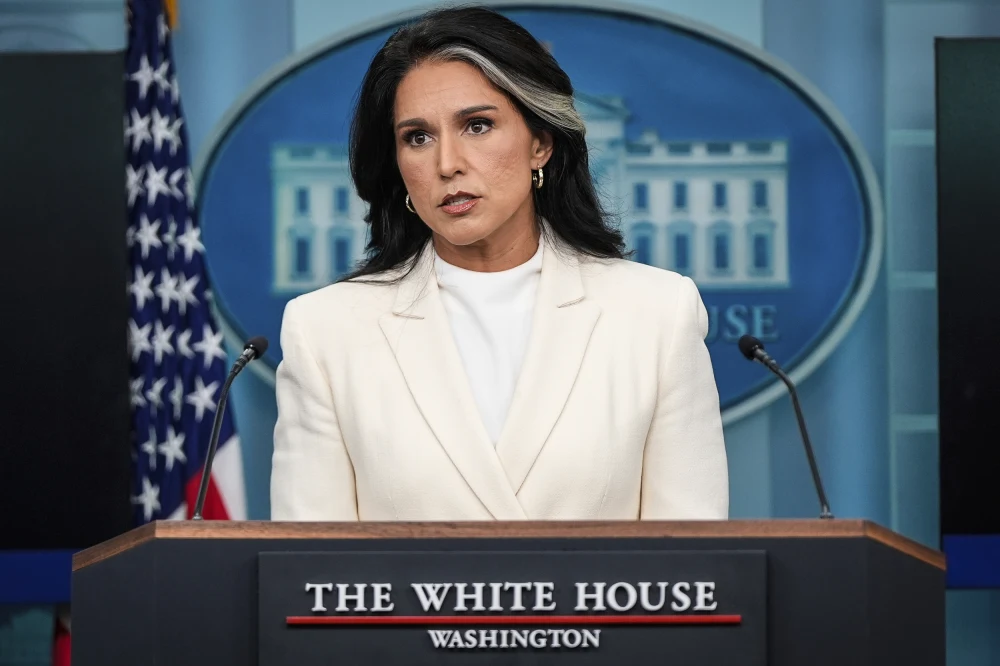
Details reveal more about whistleblower complaint against Tulsi Gabbard
A whistleblower complaint alleging wrongdoing by Director of National Intelligence Tulsi Gabbard was based on the intercept of a conversation between two foreign citizens discussing a person close to President Donald Trump, according to the whistleblower’s lawyer.
The two foreign nationals were likely associated with foreign intelligence agencies, and the president’s chief of staff, Susie Wiles, was among those who had access to the intercepted conversation, Andrew Bakaj, the attorney for the whistleblower, said in an email.
The whistleblower has alleged that the distribution of the intelligence on the intercepted conversation was restricted among administration officials for political purposes, according to the intelligence community’s inspector general. Gabbard has rejected the allegation as baseless.
The New York Times first reported on the intercept and The Wall Street Journal first reported on the whistleblower complaint.
The complaint was filed in May to the intelligence community’s inspector general and, in June, the whistleblower asked that it be shared with Congress. But the complaint was not delivered to Congress until last week, NBC News has previously reported.
Bakaj, the whistleblower’s lawyer, has accused Gabbard of moving too slowly to share the complaint with Congress and of trying to hide it from lawmakers.
Gabbard has vehemently denied the accusation, saying she acted appropriately and legally, and that the complaint is politically motivated and without substance.
Democrats in Congress have criticized Gabbard over how the complaint was handled and the delay in informing lawmakers. But in their public statements, they appear to have reserved judgment on the merits of the complaint itself.
Democratic Sen. Mark Warner of Virginia, vice chair of the Senate Intelligence Committee, told NBC News last week that the whistleblower’s complaint was heavily redacted when it was shared with lawmakers.
A previous inspector general initially found they could not determine whether the whistleblower’s allegation that the distribution of an intelligence report was restricted for political reasons was credible. Then later, the inspector general’s office concluded in a subsequent assessment based on new evidence that the allegation “did not appear credible.”
Under U.S. law, whistleblowers at intelligence agencies are entitled to keep their identity confidential.
Bakaj has said his client is prepared to meet with lawmakers to explain concerns about how the complaint has been handled by Gabbard’s office.
But the Office of the Director of National Intelligence has warned Bakaj he does not have the legal right to brief members of Congress about their client’s case.
Bakaj had informed Gabbard’s office last week that he and his client were preparing to brief lawmakers as soon as Monday about their concerns about how the complaint has been handled.
Bakaj has maintained that his client had asked for security guidance to allow for them to meet with members of Congress to discuss the complaint. But the intelligence chief had not yet provided security guidance as to how to discuss the classified material that is mentioned in the complaint, according to Bakaj.
In a letter to Bakaj, the ODNI’s general counsel, Jack Dever, rejected the lawyer’s accusations that the whistleblower complaint had been hidden from Congress and asserted that security guidance had been provided to the whistleblower.
“Your claim a right to go to Congress pursuant to the law is incorrect,” Dever wrote.
The letter was posted online by Whistleblower Aid, a nonprofit that is assisting the intelligence whistleblower.
In response to ODNI’s letter, Bakaj wrote to lawmakers leading the congressional intelligence committees, saying his team is “further engaging with the DNI to continue to seek guidance and would certainly welcome the committees’ cooperation in requesting the DNI to substantively respond.”
U.S. whistleblower laws, including the 1998 Intelligence Community Whistleblower Protection Act, are designed to allow employees in the government, including at intelligence agencies, to expose wrongdoing or other malfeasance without being subjected to retribution