My Two Best Friends and I Promised to Reunite on Christmas After 30 Years, Instead of One of the Guys, a Woman Our Age Showed Up and Left Us Speechless!
Thirty years earlier, the promise had felt simple. At that age, time still seemed obedient, something you could bend with intention and memory. You believed friendships made in youth were permanent assets, immune to distance, silence, and the slow erosion of adulthood. You believed that if you shook hands on something meaningful enough, life would step aside and let it happen.
But time doesn’t move loudly. It slips. It steals without asking. And when it’s done, it leaves you standing in places that feel familiar yet hollow, wondering how decades passed without your consent.
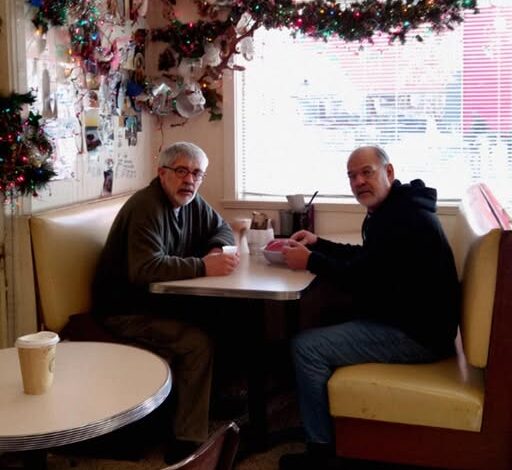
On Christmas morning, Ray stood outside May’s Diner, watching snow slide from the roof and dissolve into gray slush. The diner looked frozen in time. Same red vinyl booths. Same crooked bell above the door. Same smell of burnt coffee and grease that had followed him since childhood. This was the place. Noon. Christmas. Thirty years later.
Ted was already inside, seated in the corner booth, hands wrapped around a mug that had long since gone cold. His hair was silver now, face carved with lines that hadn’t existed the last time they’d laughed together without consequence. Still, the smile he gave Ray was unmistakable. Familiar. Anchoring.
They hugged, the kind of hug that tries to compress decades into a few seconds. No speeches. No dramatics. Just relief.
The third seat stayed empty.
They didn’t say it out loud at first, but both of them kept glancing toward the door. Rick had always been late. Always apologetic. Always arriving with an explanation that landed halfway between sincere and distracted. Thirty years of silence hadn’t erased that expectation.
They talked about the night they made the pact. Christmas Eve. A gas station parking lot. Music blaring too loud. Snowmelt on asphalt. Cheap alcohol. Loud laughter. Rick had suggested it casually, like a joke he secretly meant. Same town. Same diner. Thirty years. No excuses.
At 12:24 p.m., the bell rang.
But it wasn’t Rick.
A woman stepped inside, mid-50s, dark coat, leather bag clutched tightly at her side. She scanned the diner slowly, nervously, like someone bracing for impact. When her eyes met theirs, something heavy crossed her face. Not recognition. Not relief. Resolve.
She approached their table.
Her name was Jennifer.
She told them she had been Rick’s therapist. Then corrected herself. She was his partner. And Rick had died three weeks earlier, suddenly, of a heart attack while living abroad in Portugal. No warning. No long illness. Just gone.
The words landed like blunt force. Ted leaned back as if the booth had struck him. Ray stared at the table, trying to keep the room from tilting. The diner noise continued around them, cruel in its normalcy. Plates clinked. A waitress laughed. The world kept moving.
Jennifer explained why she was there. Rick had talked about the pact for years. He had made her promise that if he couldn’t show up himself, someone had to come in his place. Someone who knew the truth he never voiced.
What followed wasn’t an accusation. It was worse. It was clarity.
Rick had loved them. That much was undeniable. But he had always felt adjacent, never central. Close enough to feel warmth. Far enough to doubt his place. Moments they remembered as harmless—talking about girls, inside jokes, shared glances—had quietly confirmed his fear that he mattered less.
Jennifer told them about the lake day. The forgotten towel. Rick walking home alone. The dance he never attended. The postcards he wrote but never mailed. The way he kept every photo, every scrap of connection, proof that the friendship was real even when it didn’t feel reciprocal.
She slid a photo across the table. Three teenagers. Two pressed together. One standing a step away.
Rick had kept it on his desk until the day he died.
Then came the letter.
Rick’s handwriting was unmistakable. Familiar. Gentle.
He wrote that he hadn’t broken the pact. He had just needed help keeping it. That they were the best part of his youth, even when he felt like a footnote in it. That he loved them, always. That he hoped they wouldn’t turn this into regret, but memory.
By the time Ray finished reading, his hands were shaking. Ted read it twice. Neither spoke.
Later that evening, they drove to Rick’s childhood home. Dark. Empty. Waiting to be sold. They sat on the front steps, cold seeping into their bones, and listened to Rick’s voice crackle through an old cassette player. A playlist of their youth. Proof that he had never let go, even when he didn’t know how to hold on.
Sometimes reunions don’t look like celebration. Sometimes they look like reckoning.
This story resonates deeply because it taps into universal truths about long-term friendships, emotional neglect, unresolved grief, and the hidden cost of silence. In an era dominated by mental health awareness, emotional intelligence, grief processing, and relationship reflection, stories like this cut through noise because they feel uncomfortably real. They echo the lived experiences people search for late at night—stories about friendship loss, unspoken feelings, regret after death, and the emotional impact of reconnecting after decades.
It’s not just a Christmas story. It’s a reminder. About listening sooner. About asking better questions. About noticing who stands just outside the circle.
Rick showed up.
Just not the way they expected.