A Mother Raised Five Children on Her Own After Their Father Walked Away, Three Decades Later, the Truth About Their Family Changed Everything!
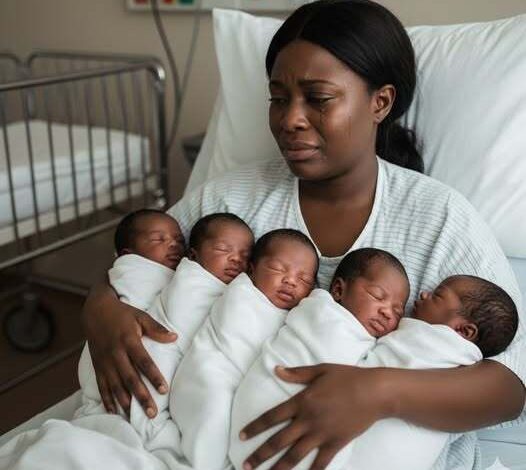
The maternity ward was still alive with movement when the nurse gently placed five newborns into their mother’s arms. Machines hummed softly, footsteps echoed down the hallway, and voices blended into a blur of congratulations. She barely heard any of it. Her focus was fixed on the tiny lives resting against her chest—five fragile hearts beating steadily, five breaths rising and falling in quiet rhythm. Against every medical concern and whispered fear, all five had arrived safely. In that moment, exhaustion gave way to gratitude, and gratitude to awe.
She waited for her partner to step closer, expecting joy to mirror her own. Instead, she saw hesitation spread across his face. His eyes moved from one baby to the next, searching for something he believed should be obvious. The longer he stared, the more distant he became.
“They don’t look like mine,” he said quietly, almost as if speaking to himself.
The words cut through the room. She reached for his hand, confused, still fogged by pain and relief, trying to reassure him. Genetics were complicated. Families were complicated. But he pulled away. Within minutes, he turned and walked out of the ward, leaving behind a stunned silence, a stunned mother, and five newborn children. He never came back.
In a single instant, she became a single mother of five. No dramatic confrontation. No explanation. Just absence.
She looked down at her babies and made a promise that would define the next three decades of her life. She would raise them with love, protect them fiercely, and never allow abandonment to define their worth.
The years that followed demanded more strength than she ever imagined. Raising one child alone is challenging. Raising five infants at once, without financial security or emotional support, was relentless. Sleep became a luxury. Time blurred. Every decision carried weight. Yet she refused to let fear take control.
She worked multiple jobs, cleaning offices late at night and taking whatever work she could find during the day. She learned practical skills out of necessity, stretching every dollar and turning scarcity into discipline. Bills were paid before wants were considered. Meals were simple but shared together. There was no excess, only intention.
The social pressure was often harder than the financial strain. Strangers stared when she walked with her children. Neighbors whispered. Landlords hesitated. More than once, she was denied housing because her family didn’t “fit.” Their appearances sparked questions she never deserved to answer. Still, she kept moving forward, grounded in quiet dignity.
Every night, regardless of exhaustion, she tucked them into bed and repeated the same reassurance. They had honesty. They had self-respect. Most of all, they had each other.
Time passed. The babies became children. The children became teenagers. And eventually, they became adults with lives shaped by resilience rather than resentment. Each child discovered their own path. One pursued architecture, drawn to structure and design. Another entered law, determined to advocate for people who felt overlooked. One found a voice in music, another in business consulting, and the youngest in visual art. Their success was not accidental. It was built on consistency, discipline, and the unwavering presence of a mother who never left.
Yet despite their achievements, the same question followed them for decades. Comments disguised as curiosity. Doubt framed as concern. The implication that their mother had not told the truth.
Eventually, the weight of it became tiring. Not because they doubted her—but because they wanted the noise to stop. Together, as adults, they made a practical decision rooted in modern genetic science. They would take a DNA test. Not for validation. For closure.
When the results arrived, they opened them together. The findings were clear. The man who walked out of the maternity ward was, without question, their biological father. There was no secret affair concealed by their mother. No deception. Only a misunderstanding fueled by ignorance and fear.
Medical professionals later explained what science has long known: genetic traits can remain dormant for generations. Recessive genes from distant ancestors can surface unexpectedly. Human DNA is complex, not predictable. What once raised suspicion had a simple, factual explanation grounded in genetics.
With that knowledge, the whispers stopped. The doubt dissolved. But by then, it no longer mattered.
Their mother never sought vindication. Her victory was quieter and far more powerful. She had raised five children alone through financial hardship, social judgment, and emotional isolation. She had done it without bitterness. Without blame. Without compromising her values.
As her children stood beside her years later, accomplished and confident, the truth was undeniable. She had succeeded not despite the hardship, but because she met it with resilience, integrity, and unwavering love.
This story resonates deeply in discussions about single motherhood, family abandonment, genetic testing, and resilience psychology. It speaks to the realities faced by parents raising children alone, the long-term impact of emotional absence, and the power of truth supported by science rather than speculation. In an era where DNA testing services, ancestry research, and genetic identity have become mainstream topics, this family’s journey highlights how easily misunderstanding can shape lives—and how quietly truth can restore peace.
The father who left believed he was escaping uncertainty. Instead, his absence became a footnote in a much larger narrative—one centered on courage, perseverance, and unconditional love. What endured was not the moment he walked away, but the decades of commitment that followed.
In the end, clarity arrived, but it was never the foundation. Love was. Stability was. And the legacy that remains is not defined by doubt, but by unity, achievement, and the extraordinary strength of a mother who stayed when it would have been easier to break.
Some families are built by biology. Others are built by choice. The strongest are built by consistency, truth, and the refusal to abandon what matters most.