A baby girl born with albinism was abandoned by her parents!
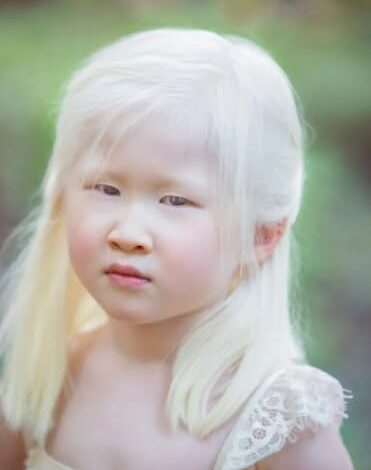
From the moment a child enters the world, their survival and sense of belonging depend almost entirely on the people meant to protect them. Parents are a child’s first shelter, their first mirror, their first definition of what it means to be safe and loved. When that bond is broken at the very beginning of life, the consequences can echo for years, shaping not only physical well-being but also identity, confidence, and the belief that one deserves to exist as they are.
Xueli Abbing’s life began with such a rupture.
Born in China with albinism, a rare genetic condition that affects the production of melanin in the skin, hair, and eyes, Xueli entered the world looking different from those around her. Her skin was strikingly pale, her hair snow-white, her eyes light and sensitive. Instead of being embraced for her uniqueness, she was abandoned shortly after birth. Left at the door of an orphanage, she was deemed “too strange,” a label that reflected fear and misunderstanding rather than any flaw in the child herself.
The staff at the orphanage gave her the name Xueli, a name filled with poetry and meaning. “Xue” means snow-white, and “Li” means beautiful. It was a quiet act of kindness, a way of naming her not by what people feared, but by what they saw: a child of rare beauty. Even in abandonment, someone chose to see her humanity.
Albinism is not a curse or a mystery. It is a hereditary genetic condition that results in reduced pigmentation and often comes with visual impairment. Yet across many cultures, people with albinism have been subjected to stigma, superstition, and cruelty. In some parts of the world, myths about magical properties have led to horrific violence. Against that global backdrop, Xueli’s story could have gone in many painful directions.
Instead, her life took an unexpected turn.
She was adopted by a Dutch family who welcomed her not as a problem to be fixed, but as a daughter to be loved. In their home, Xueli grew up surrounded by care, support, and encouragement. Her parents helped her navigate the challenges that came with albinism, particularly her limited eyesight, while also making sure she understood that her difference did not define her worth.
As she grew older, it became clear that Xueli possessed a quiet strength and a thoughtful way of seeing the world. She learned early to listen closely, to focus on voices and emotions rather than appearances. Where others relied on sight alone, she developed a deeper sensitivity to presence and intention. This perspective would later become one of her greatest strengths.
When Xueli was just eleven years old, an opportunity arrived that would change the course of her life. A designer in Hong Kong was searching for models who represented “perfect imperfections,” people whose appearances challenged traditional beauty standards. Xueli was invited to participate in a photoshoot intended to celebrate diversity rather than erase it.
She said yes.
In an interview with the BBC, she later recalled how surreal and exciting the experience was. At the time, she didn’t fully grasp the significance of being invited into the fashion world. She simply knew that someone wanted her to be seen, exactly as she was.
That moment opened doors she never expected.
Despite the fashion industry’s long history of narrow ideals, Xueli’s presence stood out. Her pale features, once the reason she was abandoned, became symbols of a different kind of beauty—one that forced people to pause and reconsider what beauty really means. But her rise was not effortless or accidental. She worked hard, learned the craft, and remained deeply aware of the responsibility that came with visibility.
She has spoken openly about the pain of seeing people with albinism portrayed as ghosts, angels, or supernatural figures. Those portrayals, she says, strip away humanity and reduce real people to symbols. “It makes me sad,” she has explained, because it reinforces the idea that albino individuals are something otherworldly rather than simply human.
Xueli considers herself fortunate in one crucial way. “I’m lucky I was only abandoned,” she once said, acknowledging the far darker realities faced by many people with albinism around the world. That awareness fuels her determination to use her platform responsibly.
A major breakthrough came when a London-based photographer recognized her potential and treated her not as a novelty, but as a professional model. Their collaboration led to a stunning photo shoot that would eventually appear in the June 2019 issue of Vogue Italia. For Xueli, the significance of the magazine didn’t hit immediately. It took time for her to understand why people around her were so excited. Only later did she realize that her image had appeared in one of the most influential fashion publications in the world.
Her presence in Vogue was not just a personal achievement. It was a statement.
Xueli has spoken about how the fashion and media industries are slowly changing. While unrealistic standards still exist, there is growing space for people with disabilities, differences, and nontraditional appearances. She believes this progress is important—but also insists that it shouldn’t be extraordinary. “It should be normal,” she says.
Because of her visual impairment, Xueli explains that she often connects more deeply with people through conversation rather than appearance. “I focus more on people’s voices and what they have to say,” she has shared. “Their inner beauty is more important to me.” That mindset shapes both her work and her activism.
Today, Xueli Abbing uses modeling as a tool for education and awareness. She wants people to understand that albinism is a genetic condition, not a curse, and that language matters. She prefers the phrase “a person with albinism” rather than “an albino,” because it places humanity before condition.
More than anything, she wants to change how the world treats people like her.
“I won’t accept that children are being killed because they are albino,” she has said. “I want to change the world.” These are not empty words. They come from someone who has lived the consequences of fear and misunderstanding, and who has chosen to respond not with bitterness, but with purpose.
Xueli’s journey—from an abandoned infant to an international model and advocate—is not a fairytale. It is a testament to resilience, to the power of compassion, and to what can happen when someone is given the chance to grow without shame. Her life reminds us that beauty is not a narrow mold, that difference is not a defect, and that the labels society assigns can be rewritten.
She was once left behind because people didn’t understand her appearance. Today, she stands in front of cameras and audiences around the world, reshaping perceptions and opening minds.
The snow-white baby once seen as “too strange” has become a voice, a presence, and a force for change. And her story continues, driven by the hope that no child will ever again be abandoned simply for being born different.