When a Family Disagreement Over a Rescued Puppy Changed Everything!
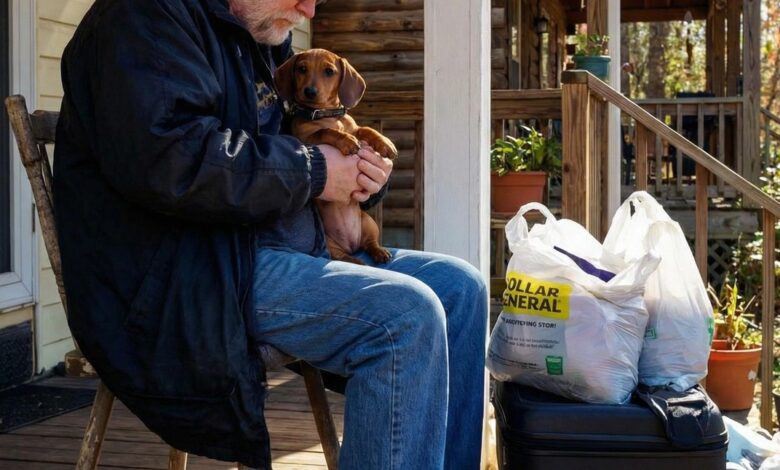
I pulled into my granddad’s driveway expecting the usual: a quiet weekend, a cup of coffee on the porch, maybe the same old stories I’d heard a hundred times. Instead, I found him sitting outside with a packed suitcase, two trash bags, and a tiny injured puppy tucked against his chest like something precious he refused to let go.
He looked older than his 86 years, worn thin by time and grief, but the way he curled his arms around that puppy told another story entirely — one of stubborn hope.
Two years had passed since my grandmother died, and in that time my dad and stepmom, Linda, had moved into the house “to help him out.” At first, it made sense. He was lonely, the house too big, the memories too heavy. But little by little, I noticed how those memories were being erased.
My grandmother’s photos disappeared from the hallway. Her handmade curtains — bright, floral, full of life — were replaced with plain beige panels. Her dishes were packed away, some “donated,” some “put in storage.”
Whenever I asked about it, Granddad smiled gently, as if trying to convince both of us that he didn’t mind. But he did. I could see it in the way his eyes lingered on empty walls.
Everything shifted the night he visited my grandmother’s grave and found a tiny, injured puppy whimpering in the grass near the headstone. He scooped her up, wrapped her in his sweater, and named her Penny because, as he told me later, “she was small, copper-colored, and worth more than she knew.”
He took her to the vet, fed her with a syringe, and sent me photos every single day — Penny in a blanket, Penny asleep on his lap, Penny wobbling around on unsteady legs.
For the first time in years, there was light in his messages again.
So seeing him exiled to the porch — suitcase at his feet, eyes full of shame — snapped something in me.
“What happened?” I asked, stepping out of the car before the engine even stopped shaking.
He stroked Penny’s head and sighed. “Linda said the dog is a burden. That I need to get rid of her. When I refused, she said maybe I should find somewhere else to live if I’m going to ‘act irrational.’ So… here we are.”
He said it gently, like he didn’t want to make anyone the villain. But the sight of an 86-year-old man pushed out of his own home — the home he’d shared with my grandmother for over sixty years — made my blood boil.
I loaded his bags into my car and checked him and Penny into a pet-friendly hotel that night. I told him he was not losing his home, not like this, not after everything he’d already lost. His eyes filled with quiet relief, and he held Penny a little tighter.
While he slept, I stayed up digging through old files, hunting down every document that proved — beyond all doubt — that the house belonged to him alone. Deed, mortgage payoff, property tax records. All of it.
The next morning, I went back to the house. Linda met me at the door with crossed arms and the kind of expression usually reserved for overdue bills and moldy leftovers.
She tried to tell me she was “only doing what’s best,” that the dog was “dangerous,” that Granddad “wasn’t thinking clearly anymore.”
She didn’t realize my friend, who worked in the local news station, stood behind me recording everything. Calmly, I let her talk. I let her explain how she believed she had the authority to make decisions about the house. I let her claim she was the one keeping things together.
Every confident word she spoke only proved how wrong she was.
That afternoon, I invited her to join us at the hotel restaurant. Granddad sat beside me, Penny curled at his feet, healed enough to wobble around but still glued to him like he was the only safe person in the world.
When Linda arrived, irritated and already rolling her eyes, I laid out the property documents in front of her. Then, without raising my voice, I hit play on the recording of her own words.
Her expression shifted from annoyance to confusion… and then to panic.
The truth was no longer something she could bend into the shape she wanted.
My goal wasn’t to humiliate her — I genuinely hoped she’d understand the gravity of what she’d done. But I wasn’t about to let anyone push my grandfather out of the home that held every memory of his life with the woman he loved.
Linda left without another argument. And for a moment, it felt like the dust was starting to settle.
A few weeks later, my dad returned from a work trip and learned everything. The suitcase on the porch. The confrontation. The recording. The attempt to evict an elderly man over a puppy that had become his lifeline.
He confronted Linda, and after days of arguing, tears, and revelations, they decided to separate. It wasn’t easy, but it was inevitable. Something fundamental had cracked.
Granddad moved back into his home — his home — with Penny trotting after him on her now-healed legs.
And the change was immediate.
The photos of my grandmother reappeared on the walls.
The floral curtains were rehung, the ones she’d sewn by hand with tiny uneven stitches.
The house smelled like coffee and lemon cleaner again instead of sterile nothingness.
When I visited next, Granddad sat in his old recliner, Penny curled up beside him like she’d always belonged there. He looked peaceful in a way I hadn’t seen since before my grandmother died.
“She saved me, you know,” he told me one afternoon, scratching Penny’s ears. “I thought everything was over. Then she came along and reminded me that the world still has new beginnings tucked into unexpected corners.”
I sat next to him, watching Penny snooze with her tiny paws twitching, and realized he was right.
Sometimes love doesn’t come crashing in with fireworks. Sometimes it arrives wounded, quiet, and small enough to fit inside your hands — but strong enough to rebuild a life from the inside out.
And sometimes the greatest act of loyalty isn’t a grand gesture.
It’s simply standing up for the person who spent their whole life standing up for you.